


Silent Sunday Stills

We are now on the warmer side of winter; nights are not as cold and days are getting longer. There is not long to go until the wheat starts to senesce and we begin preparing for harvest.

We have not had any rainfall since March and it’s pretty dry, so until the drying out period for the wheat begins it’s important that we keep on top of our irrigation program.

Power outages are normal around here. They happen almost daily and although we usually receive notification in advance, they can be quite disruptive to farming operations. When we woke up to no electricity this morning – with no prior warning – Piet contacted our local electricity supply company (ZESCO) who told him that power was out for maintenance. He then posted a question on the WhatsApp ZESCO chat group and got this response:

Which was quickly amended to:

Having elephants as neighbours can be rather trying at times!

It’s rained so much the soya-beans dropped by the combine harvester have started to germinate – the resilience of life never ceases to amaze me.


Pop over to Lindaghill’s blog to see more One-Liner Wednesday posts.
This year has been a very dry one for us. Our records show we have only received 245mm of rainfall. Compared to last year’s 1,500mm that’s abysmal, and it would have been a disaster farming-wise if we weren’t able to draw water from the Zambezi River for irrigation.
But dry weather makes ideal harvesting weather and we started lifting soya beans by hand last week in anticipation of the combine arriving on Monday to finish the job.
Our peanut crop was also ready for harvest and so last week it was all systems go! The ‘new’ second-hand peanut harvester we bought earlier this year and the tractors had been serviced, 50 extra hands had been hired and Piet was up before light, doing last-minute checks and reminding everyone of their duties.
Within minutes Piet realised something was amiss with the peanut harvester. It was blocking up with nuts and debris and just not doing the job properly. And so the frustrations began, and continued throughout the week and over the weekend.
Piet and the farm mechanic tinkered and tapped, removed parts, cleaned and then replaced them. They swore (a little), paced and scratched their heads. And they sweated! Temperatures (and tempers) were rising and clouds started forming on the horizon.
Eventually, on Monday, Piet conceded defeat, phoned around a bit and with a lot of perseverance and a little luck found a mechanic who specialises in fixing peanut harvesters – we are expecting him to fly in from Johannesburg today.
On Tuesday morning Piet realised that rain was inevitable, so he arranged to have some of the harvested nuts moved into our old managers house (our sheds are too full with next season’s fertilizer) where they would stay dry – the mechanic will need some dry material to test the machine with. Normally the harvested nuts are windrowed and left to dry in the fields – because it is normally dry at this time of year.
Then on Tuesday afternoon those clouds rolled in and it started raining. And it rained. And rained. And rained. It rained all through the night and only stopped at around 10 o’clock this morning, April 1st.
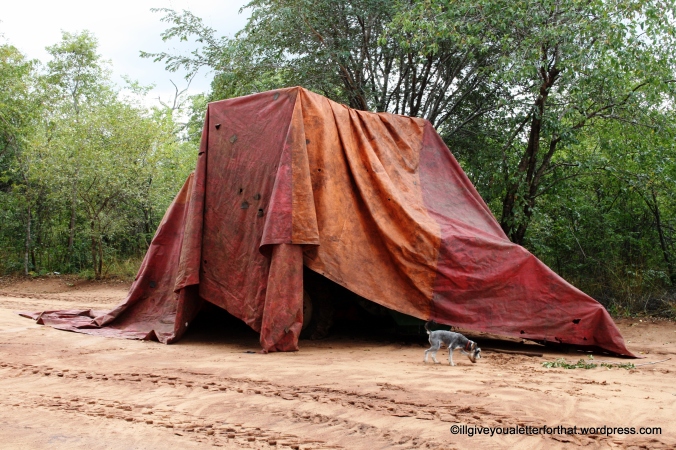
The offending peanut harvester hiding in shame
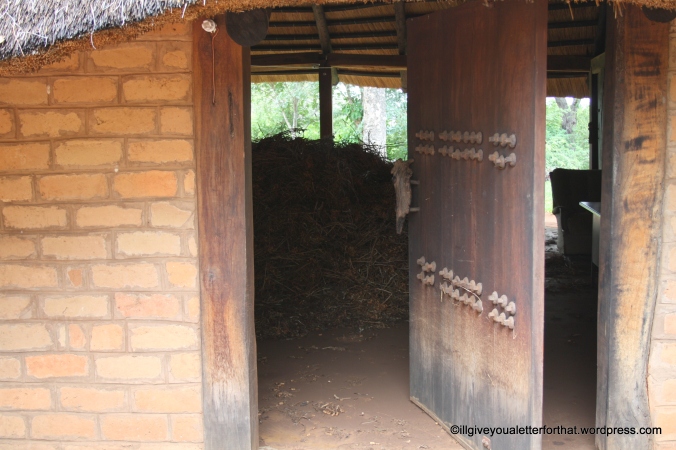
Come on in – grab yourself some peanuts
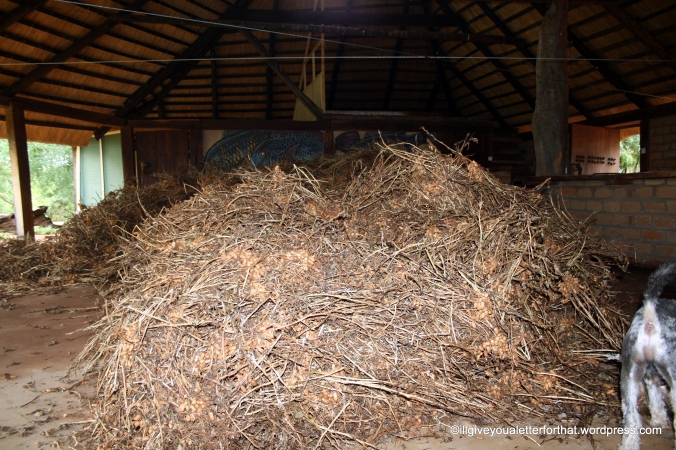
A pile of (dry) peanuts.
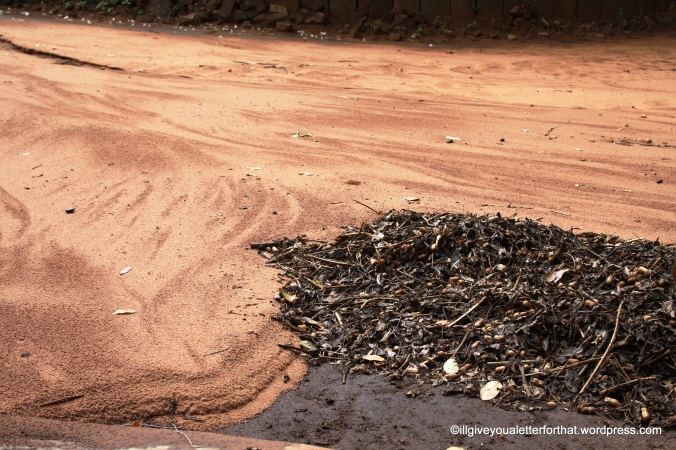
These are not so dry
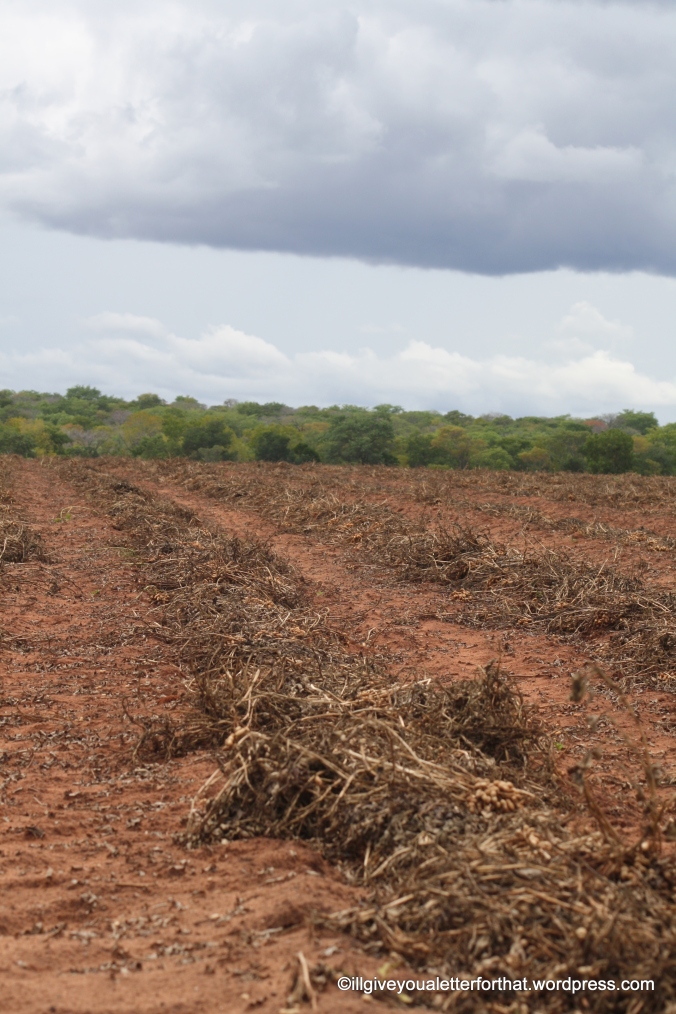
Soggy windrows – and it’s threatening to rain again …
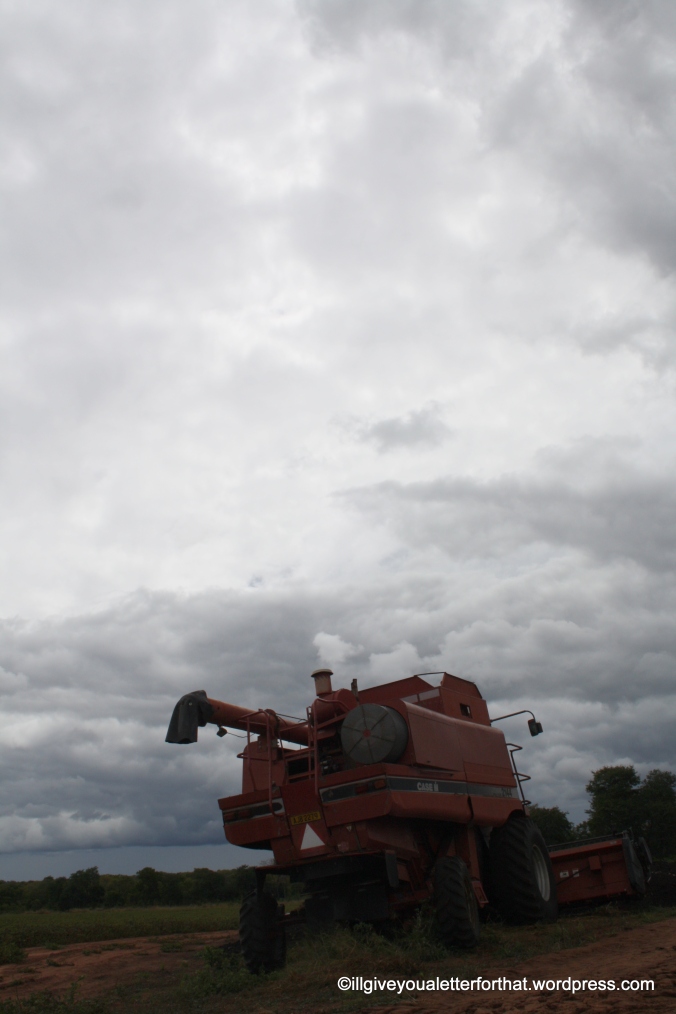
Waiting for a sunnier day
Certainly an April Fools Day for us, although not a particularly funny one.



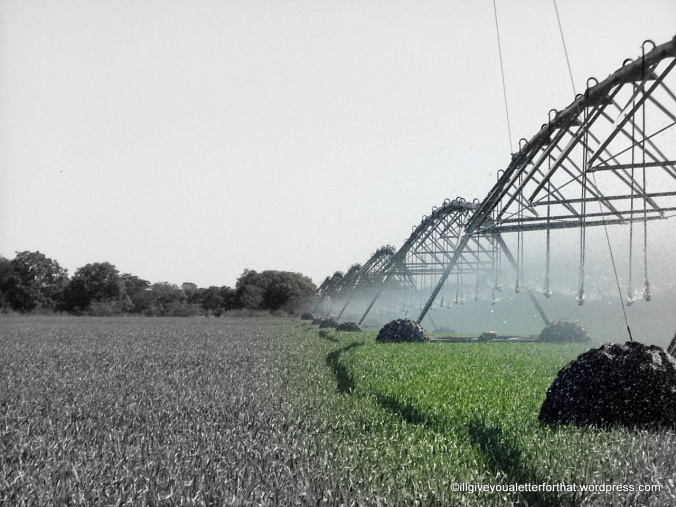
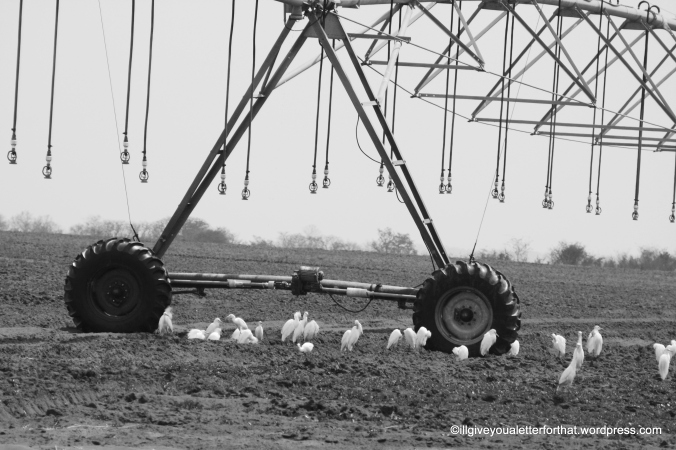
The constant circling of the centre pivots, round and round on the same tracks, creates ruts in the fields. Add water to that and you get a muddy, sticky quagmire and the wheels often become stuck.
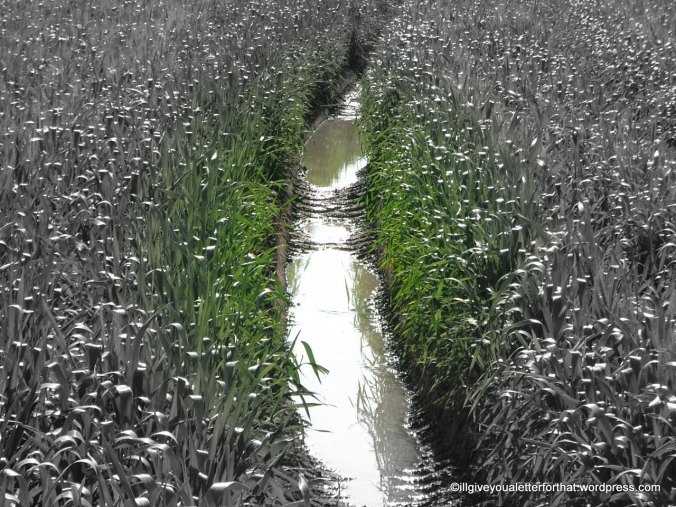
This can become quite expensive, especially if it happens at night and the pivot attendants have fallen asleep on the job; the wheels keep churning in one place, digging deeper and deeper into the mud, bearings seize, motors burn out and people lose their jobs!
It was an arduous and back-breaking daily task carting small rocks into the fields to fill in the ruts.
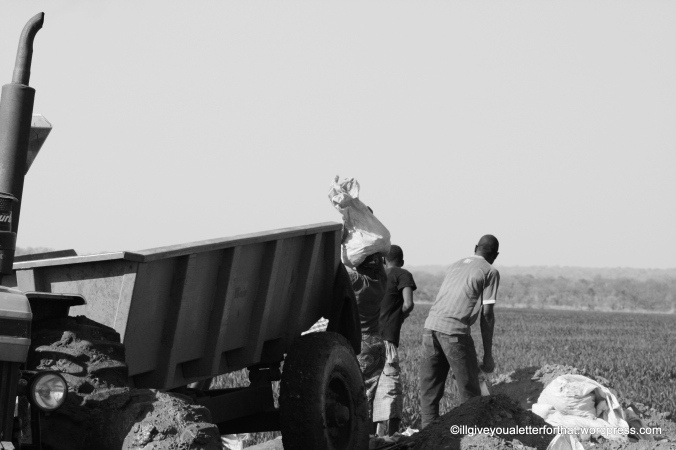
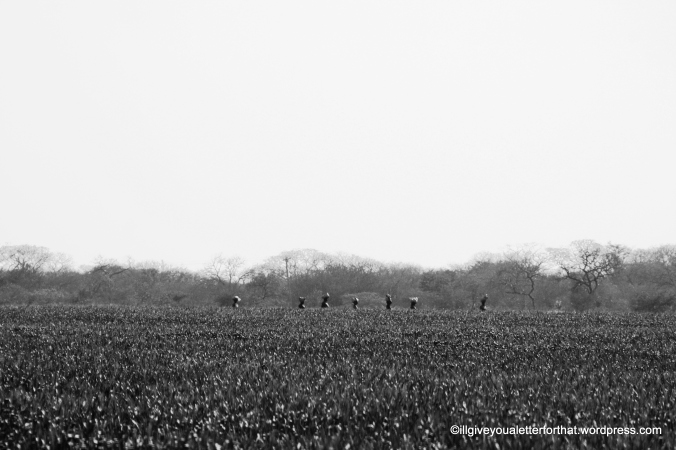
So this year Piet decided to fix the problem once and for all. We hired a back-hoe, dug ourselves some gravel and deposited it along all the wheel tracks, forming a more solid road for the pivots to travel along.
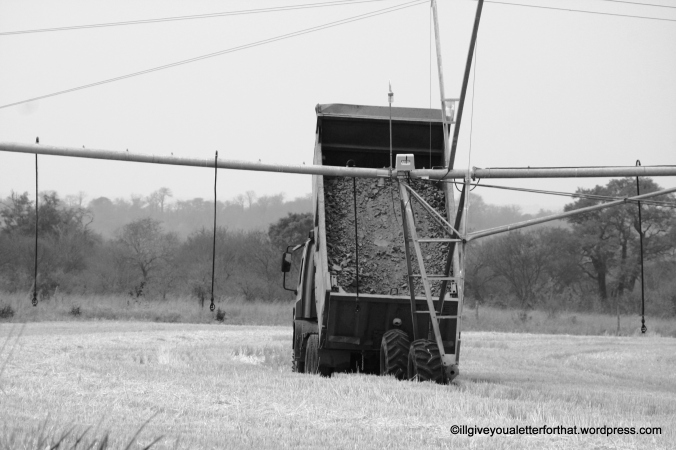
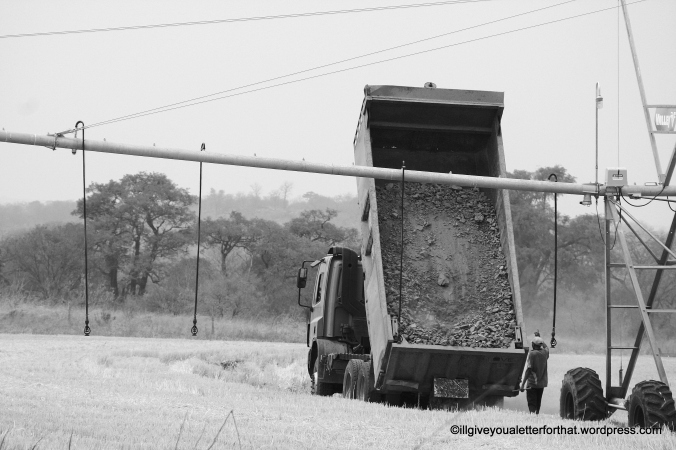
This has certainly made life a little easier for everyone.

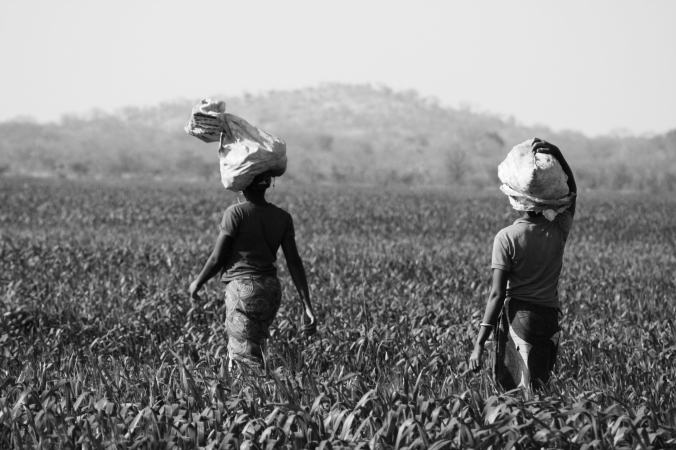
Balancing Act
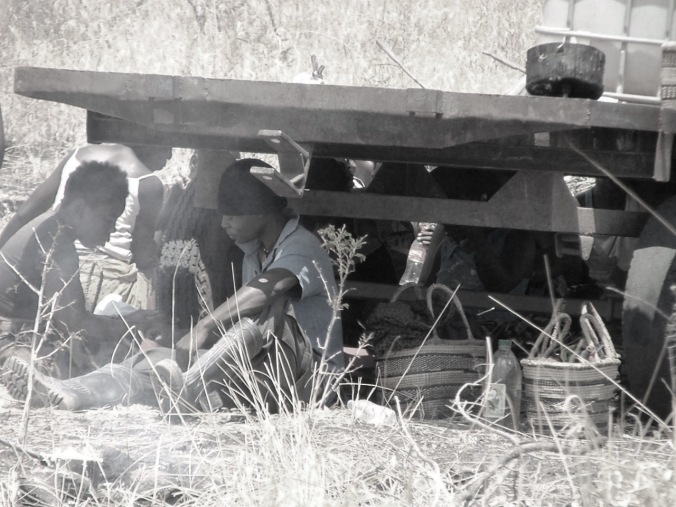
Respite from the blazing sun
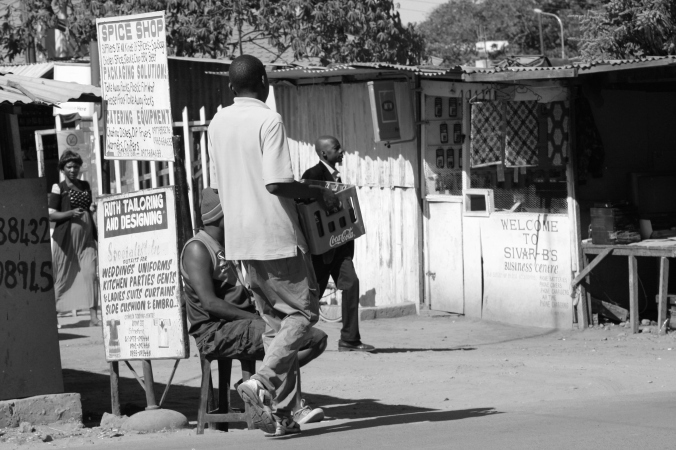
Market scene – Livingstone, Zambia
The Daily Post Weekly Photo Challenge – Silhouette
Photography is all about experimenting with light, and then positioning yourself (or your subject) in the right spot to achieve a certain effect. One such effect is a silhouette, in which an outline of someone or something appears dark against a lighter background. Silhouettes can be very dramatic and resemble black shapes without any details, but the effect varies from picture to picture.

Yellow-billed Kites feasting on flying ants

Crepuscular Yellow-billed Kites

Midges dancing in the setting sun – Zambezi River


Master of all he surveys
When Piet first arrived here nine years ago the farm now known as Sitikela was bush. Thick, solid, tangled, dry bush. And it was brown. The trees were brown, the grass was brown, the leaves scattered on the sand were brown – even the sand was brown.

African winter bush

As he drove up a sandy, unkempt track he noticed the top of a solitary tree towering above the rest of the forest – and it was green! Although it was mid-winter, the heat of the day was almost unbearable and the shade of this tree looked like a likely spot to set up camp; Piet and Sarel, his business partner, lived in tents under that tree for two years while they set to work developing the farm and today our house nestles comfortably in that same shade.

Home Sweet Home

The rough and the smooth
Guibourtia coleosperma, also known as Rhodesian Copalwood, African Rosewood and Large False Mopane is a beautiful, mostly evergreen tree which occurs almost exclusively on Kalahari sand. The tree is ubiquitous on our farm and we have at least ten growing in our garden. Our offices are also built under the shade of one of these magnificent specimens.

I love the varying textures of the bark, smooth, cracked, knotty.

Pockmarked with borer tunnels

The paired leaves look similar to those of the Mopane tree (Colophospermum mopane) which also occurs in this area and it is easy to understand why this tree is sometimes called the Large False Mopane.

Shining emerald-green in the sunlight

Almost translucent from underneath
The bright red arils, although somewhat tasteless, are edible and the indigenous people pound them into a flour which they cook into a nutritious meal; they do the same with the seeds and I have read somewhere that this has saved many lives in times of famine.


Of course birds love the seeds and arils too, and we are often entertained by the raucous shouting of trumpeter hornbills, sounding uncannily like crying babies as they skirmish and scuffle for the juiciest ones.

Guibourtia coleosperma is a much sought-after hardwood. When first cut the timber has a unique pinkish-brown colour which later changes to a rich, warm, edible-looking dark chocolate-brown.

Our own home-made Rosewood dining-room suite, made from wood salvaged during land clearing
Free Range Learning, Creative Living, Gentle Encouragement, Big Questions, Poetry, Occasional Drollery
Captivating Timeless Beauty
Hi! my name is Sebastian (You can call me Seb!) ...welcome to my Blog. I'm a photographer from Worcester, Worcestershire, England. Thanks for dropping by! I hope you enjoy my work.
Atheist approach to truth through promoting science and challenging faith.
A picture, some words and a bit of harsh reality
A Peace Corps Journey
Tripping the world, slowly
"Summer is the Season of Inferior Sledding" -- Inuit Proverb. Martha Ann Kennedy's Blog, Copyright 2013-into perpetuity, all rights reserved to the author/artist.
The ramblings and photos of a Naturalist
For Exceptional People Everywhere
Join me in the cold, dark, life-sustaining NE Pacific Ocean to discover the great beauty, mystery and fragility hidden there.
Keeper of fluttery thoughts
Exploring the Reptiles and Amphibians of Africa
Medieval History, Pop Culture, Swearing
Live Life Write
Columns. Letters. Rants. Stuff.
My thoughts, sentiments, and scribbles on womanhood
Steve Harrison and Janine King's other Hot and Sticky web site
Little windows into my world.
Fun With SCIENCE!
trials and tribulations of a quaterlife crisis
For people with Non-24-Hour Sleep Cycles
Lisa Batten Kunkleman
BLIND WILDERNESS
an irreverent look at UK politics
Ruminations and reflections on the world of literature...
debunking the reasons people don't vax
A LOT OF P'S WITH A BIT OF QUIRKINESS THROWN IN FOR GOOD MEASURE.
Growing with gratitude for life's challenges
Wits End Photography
Exploring my world with pictures and words.
photography, poetry, paintings
Photographing.... that one moment in time...
All Is One With Our Creator
age is just a (biggish) number
Everyone Has Something To Teach Us
To participate in the Ragtag Daily Prompt, create a Pingback to your post, or copy and paste the link to your post into the comments. And while you’re there, why not check out some of the other posts too!
Creative Exploration in Words and Pictures
To See a World in a Grain of Sand...
I write to figure out what is left
Fun, Photography & Friends
An onion has many layers. So have I!
A blog about blood-brain barrier, science, metal, old-school gaming and other geeky stuff
Looking at the conflict around the world.
Do you want to beat the bite of mosquitoes? This is a summary of research projects and publications dealing with mosquitoes, mosquito-borne disease, insect repellents, urban wetlands and urban ecology (as well as other Medical Entomology activities) by Dr Cameron Webb (University of Sydney & NSW Health Pathology)


 I'll Give You a Letter For That