The Daily Post Weekly Photo Challenge – Silhouette
Photography is all about experimenting with light, and then positioning yourself (or your subject) in the right spot to achieve a certain effect. One such effect is a silhouette, in which an outline of someone or something appears dark against a lighter background. Silhouettes can be very dramatic and resemble black shapes without any details, but the effect varies from picture to picture.
Zambia
The Textures of Africa – Part II
When Piet first arrived here nine years ago the farm now known as Sitikela was bush. Thick, solid, tangled, dry bush. And it was brown. The trees were brown, the grass was brown, the leaves scattered on the sand were brown – even the sand was brown.
As he drove up a sandy, unkempt track he noticed the top of a solitary tree towering above the rest of the forest – and it was green! Although it was mid-winter, the heat of the day was almost unbearable and the shade of this tree looked like a likely spot to set up camp; Piet and Sarel, his business partner, lived in tents under that tree for two years while they set to work developing the farm and today our house nestles comfortably in that same shade.
Guibourtia coleosperma, also known as Rhodesian Copalwood, African Rosewood and Large False Mopane is a beautiful, mostly evergreen tree which occurs almost exclusively on Kalahari sand. The tree is ubiquitous on our farm and we have at least ten growing in our garden. Our offices are also built under the shade of one of these magnificent specimens.
I love the varying textures of the bark, smooth, cracked, knotty.
The paired leaves look similar to those of the Mopane tree (Colophospermum mopane) which also occurs in this area and it is easy to understand why this tree is sometimes called the Large False Mopane.
The bright red arils, although somewhat tasteless, are edible and the indigenous people pound them into a flour which they cook into a nutritious meal; they do the same with the seeds and I have read somewhere that this has saved many lives in times of famine.
Of course birds love the seeds and arils too, and we are often entertained by the raucous shouting of trumpeter hornbills, sounding uncannily like crying babies as they skirmish and scuffle for the juiciest ones.
Guibourtia coleosperma is a much sought-after hardwood. When first cut the timber has a unique pinkish-brown colour which later changes to a rich, warm, edible-looking dark chocolate-brown.
The Textures of Africa – Part I
Cee’s Which Way Challenge: 2014 #10
The Mulobezi Express winds its way between Livingstone and Mulobezi – a logging village in the middle of nowhere – and bisects the farm, almost down the middle. We have to cross it many times a day to get to the top fields.
Derailments are a regular occurrence and often it is out of action for weeks. When this happens the passengers all rally together and using logs as levers and a lot of elbow grease and sweat, somehow manage to lift the train back on its tracks.
When it is in operation we hear it come rattling past twice a week, its wheels screaming in protest – sometimes very late at night – loaded to capacity with people, livestock and goods if it is heading towards Mulobezi, and logs for its return journey. It sounds as if it is heading directly towards the house, which is very unnerving and the dogs always go barking crazy, tearing up and down the fence shouting insults.
Maintenance is a very loose term in this part of the world but from time to time a crew of men are sent along the line to check for problems and, if they can, to fix them. They are always a cheerful bunch and we can often hear their laughter and singing echoing through the trees as they make their way deeper into the forest (the dogs don’t like this either!).
Lucky Friday 13th
Weekly Photo Challenge – Zigzag
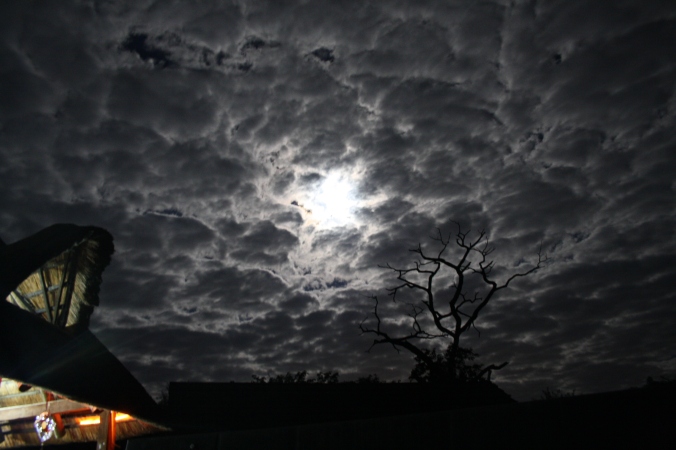
I have tried many times to photograph the full moon but my attempts are usually hopeless.
So I was delighted with this eerie result.
It’s All in a Day’s (or is it night’s?) Work
I have a farm in Africa.
Well, I don’t but Piet does, although to be quite correct, he doesn’t have a farm, he leases it – as does every farmer in this part of the world.
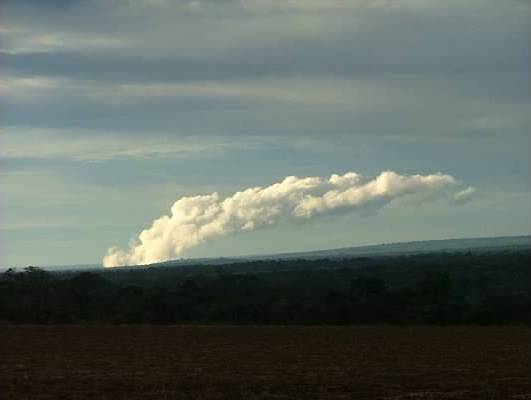
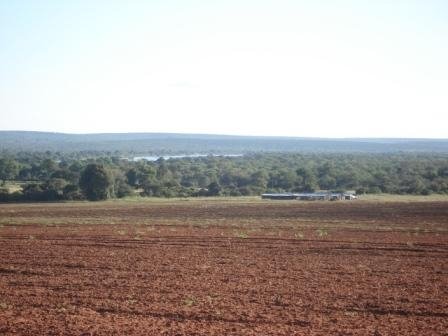
It is a 560Ha farm, split into two sections; one large one and one small. The larger section, which we have named Sitikela Farm (sitikela means roller – a beautiful, colourful bird which occurs in this area – in Lozi), sits proudly on top of ancient sand dunes, blown in from the Kalahari Desert over millennia and boasts panoramic views of the mighty Zambezi River. In some places you can even see on the horizon the mist rising high and billowing cloud-like from the Mosi oa Tunya (or Smoke That Thunders), more commonly known as the Victoria Falls, one of the Seven Wonders of the World.

This picture was taken some years ago – now this magnificent view is marred by an ugly cellphone tower.
Photo credit: Piet
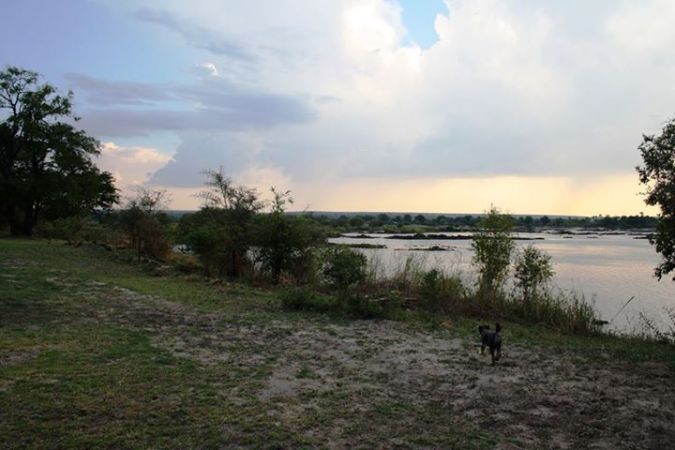
The second, smaller section is about 7km away, situated on the banks of the Zambezi River.
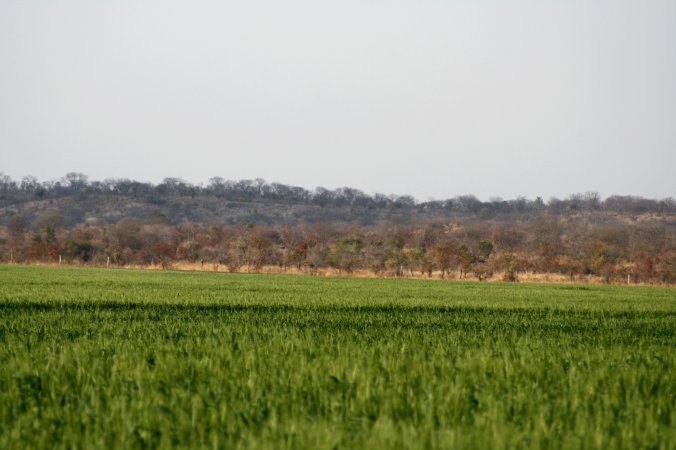
During the winter months we grow wheat and seed-maize (corn). The seed from the maize we grow is sold to other farmers and ultimately their produce is ground into ‘mealie-meal’, the staple food for the indigenous people around here. We truck the wheat off to millers about 400km away where they turn it into flour.
It so happens that also in the winter months it does not rain, the bush dries, the grass dies and the locals start burning what’s left. This leaves very little food for the many large herds of elephants (and other game in the area) to eat – and so they all come to our farm!
We employ a number of Security/Elephant Guards who work in pairs and who are armed with a stash of fire-crackers. In theory, their job is to patrol along the edges of the fields at night, listening for elephants. As soon as they hear elephants approaching they are supposed to throw a few crackers to scare them off and then radio ‘control’ who alerts Piet, either via radio or telephone, so that he can go and back them up with more fire-crackers and the added pressure of a vehicle.
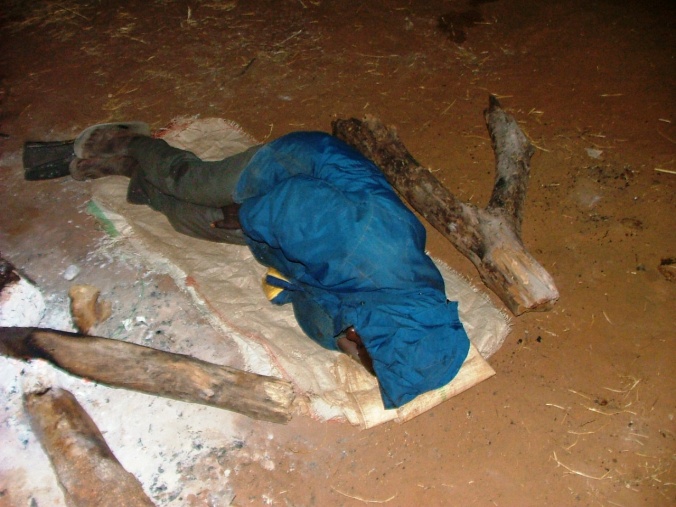
In practice what they often do, unfortunately, is sleep, while the elephants take their fill.
It was very frustrating (and expensive!) for Piet to wake up after a full night’s ‘elephant-free’ sleep, only to discover half the crop eaten, and the other half trampled flat by elephants. So he devised a system for keeping everyone awake and alert – this works very well. Every 15 minutes control calls each station on the radio, asking for their sit rep (or situation report). If all is quiet they reply by saying November Tango Romeo (Nothing To Report). This standardisation of reply avoids the confusion of multiple answers, such as “Ah, it is just cool” or “It is just OK” or even “ What is the football score?”. If there are elephants near the response is supposed to be ‘Echo India Lima’ – Elephants In Lands – but all protocol is usually forgotten in the excitement and one evening we were amused to hear frantic shouting over the radio:
“November tang romeo! November tango romeo! But tell the bwana to come fast! The elephants, they are many!”.
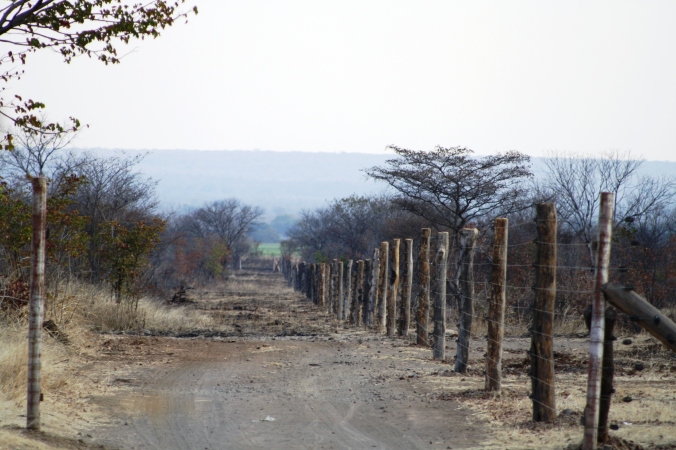
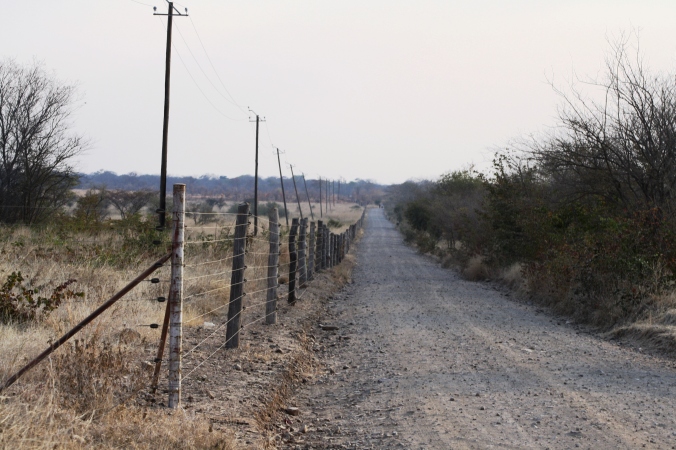
In addition to the guards we also have 20 Km of electric fencing around the borders of the lands.
But we found that this did not really deter them. Elephants are very intelligent creatures and sometimes they push a foot against one of the poles, the fence falls flat, they step daintily between the wires and voilà! Pudding time! Other times they are not as delicate or thoughtful; Piet has witnessed teenage bulls pushing their younger and smaller siblings or cousins through the fence – those unfortunate babies squealing in anticipation of the pain, even before they reach the fence!
So another plan had to be devised. We have now connected the wires on the fence to an alarm which is activated if the circuit is broken. We at least then know there has been a breach and can scramble into action.
Last year we were visited by a man who had heard of our plight. He said he has devised a method of keeping elephants out of villagers’ crops in Kenya using flashing strobe lights attached to poles. By all accounts this system works but only when there is a light every 10m – that would mean at least 2000 lights for us and the cash layout would just be too great for an operation our size.
Sometimes we are lucky. If the wind is blowing in the right direction all it takes is the sound of the vehicle starting up in our yard for the elephants to hurriedly leave. But other times not so lucky; many nights Piet gets his first call-out before the sun has set and only returns home after sunrise the next day. He then has to carry on his business of farming, maybe catching a few minutes sleep in the late afternoon before the next incursion. On some occasions we have had over 100 elephants on the farm. It’s almost as if it’s a planned military exercise – they split up into groups, dashing out of one field as the vehicle approaches, into the bush and then into the next field. You can imagine them laughing and thumbing their trunks at these futile attempts to keep them away from the food. At times like these he will often call in one of the drivers to assist with a tractor. Or he will enlist the help of friends who have popped in for dinner – however we have found visitors are scarce during the Elephant Season!
Chasing elephants is an exhausting and dangerous job. But it has to be done if the bills are to be paid. And unless the villagers can be persuaded to not set fire to everything in winter, it is something that we are going to be doing forever.
An Elephant Never Forgets – Post Script
Two days after our close encounter we were again driving home through the park when we noticed a lot of dust blowing into the road up ahead. It was late afternoon, the sun was very low in the sky and visibility was not great, so we slowed right down; if a herd of elephants was about to cross we didn’t want to run straight into them. As we drew closer and were engulfed in the dust cloud we saw that it was indeed a large herd of elephants moving through the bush on our right hand side.
We were alongside the herd when suddenly, from the opposite side, a tiny baby elephant came rushing out of the bush – directly into the path of our vehicle. Thank goodness for Piet’s quick reactions (and for ABS brakes)! We screeched to a halt not more than two metres before hitting the elephant – who was now squealing with fright, his bum tucked in, his trunk straight out, his little legs a blur as he made the final dash to his Mum and the rest of his family.
In the moments before we gathered our wits and drove off we could hear his Mum reassuring him with her low, rumbling murmurs.
Thankfully we were in a different vehicle, not the elephant-chasing one. The elephants didn’t recognise us and we were left to carry on our journey home unscathed.
An Elephant Never Forgets
Last Tuesday we were driving through the park on our way home from town when we noticed a mini-bus parked on the side of the road. This usually means there is something worth looking at, so we slowed down to see what they had stopped for and pulled up behind them. Every head in the bus was turned to the right, necks craning as they tried to get a better look at something there in the bush. We followed the direction of their gaze, struggling at first to see what it was – and then suddenly there they were! Lumbering slowly into view came an elephant cow with her very small calf and an older sibling also in tow.
We sat watching and hoping for the opportunity for some decent photos when she suddenly lifted her head and looked directly into Piet’s eyes. She uttered a low, rumbling sound, shook her head and started moving directly towards our truck.
At this point Piet engaged gears and quickly pulled out into the road. By the time we had passed the mini-bus the elephant was on the road, running after us and screaming; her ears pinned back and her trunk down. She too overtook the mini-bus, its stunned occupants gaping after us, open-mouthed. She appeared intent on catching only us and it was only after we had retreated some distance that she turned around and loped off, back into the bush to join her two children.
The elephants in our park are not normally aggressive but I have a theory about why this cow took umbrage. I reckon that she belongs to one of the many herds that regularly raid our crops in the winter months. The vehicle we were traveling in is the same one Piet uses for his nightly chasing-the-elephants-out-of-our-crops escapades. She most likely recognised the sound of the vehicle and probably also the smell of Piet, associating those two things with being harassed and deprived of our juicy, tasty maize (corn) and wheat when there’s not much else around to eat. She remembered her frustration and here was the perfect opportunity for her to show us just how annoyed he had made her so many times in the past.
Indeed, an elephant never forgets!
Containers. The Daily Post – Weekly Photo Challenge.
Limbikani
Some time in the mid-1970s I lived with my parents on a tobacco farm in the North East of Zimbabwe (then Rhodesia). The bush war was reaching its climax. Living in the area was becoming more dangerous, so Dad decided to relocate to a sugar cane farm in the South East Lowveld, where it was considered to be (a little) safer.
One night while he was doing his rounds checking the tobacco barns one of the guards, an ancient-looking, wizened old man called Limbikani, sidled up to him and muttered out of the corner of his mouth that he had heard we were leaving. Dad was surprised; we had only decided to move a few days before and had only discussed it among ourselves, at home. It’s amazing how the bush telegraph works!
Limbikani’s next words surprised Dad even more:
“If you don’t take me with you I will put mtagati (bad medicine) on you”.
We had already decided that we would ask Limbikani if he wanted to come with us – he was too old for gainful employment by anyone else and besides, Dad was quite fond of him – but Dad feigned fear of his threat and readily agreed. We later learned that Limbikani was a well-respected nganga (witch doctor) and people would come from miles around to have him throw bones to diagnose illnesses or to give them spells to ward off mtagati.
A few weeks later I was back at boarding school in Harare (Salisbury) and my parents called in to visit me on their way to our new home. The sight of our small, battered pick-up truck, fully loaded with Limbikani, Evalina – our housekeeper, two Irish Wolfhounds, one Maltese Poodle cross, Moggie our ancient ginger cat, 15 Bantam chickens, Gertie our goat and all our belongings caused much amusement to my fellow students – to me it was normal.
Not long after we had moved, Limbikani demonstrated his super-natural powers. Our old truck was on it’s last legs by then and one day it stalled about 200m from our farm gate. Staff were called to help push but no amount of coaxing could get the engine running again. Mum was about to start walking the rest of the way home when she noticed the staff had all stepped back and she heard them murmuring Limbikani’s name. She looked up to see he had materialised, almost from no-where (there had been no sign of him when the pushing was required), and was shuffling out to meet her. He instructed her to close the bonnet – which had been up while she fiddled about in vain with spark plugs and battery terminals – and then pressed his hands on the top of the bonnet several times, muttering under his breath as he did so. After a few minutes of this trance-like behaviour he shook himself, told her he had fixed the car, and motioned for her to get back in and start it. She did so dubiously, not really believing in all this mumbo-jumbo stuff but also not wanting to offend the old man. One turn of the engine and it fired into life – she couldn’t believe it! Limbikani simply shrugged and slowly walked to the gate to open it for her. Mum was now convinced that Limbikani was indeed a nganga but Dad always said she had probably flooded the motor and that it would have started after a while anyway, once the excess fuel had evaporated.
At lunch time one Sunday Limbikani came to the house to request some extra cash; he wanted to go to a nearby beerhall to drink beer and watch a local football match. Feeling magnanimous, probably having imbibed a couple himself, Dad not only gave him the cash but also poured a very generous tot of brandy into a glass and handed it to Limbikani. Limbikani’s eyes lit up, he downed the entire tot in one gulp and immediately burst into song. By the time he reached the end of the driveway he was staggering and it is doubtful that he made it to the beerhall that day. This became a weekly ritual. After a while, the state of Limbikani’s liver being of concern, my Dad tried a different tactic. Instead of handing the glass of brandy directly to Limbikani Dad started placing it on the table, Limbikani would then gratefully take his tipple home with him, to enjoy its contents at his leisure.
As Limbikani got older (to me this seemed impossible, he already looked at least 100 years old) his duties in our garden were reduced to some weeding and occasional tidying up. These he would complete in an hour or so and he would then retreat to ‘Limbikani’s Corner’, a grassy part of our garden shaded by a baobab tree, where he could sleep, contemplate life and suck on baobab pips.
One Sunday Limbikani did not appear for his weekly tot. My parents had seen him early in the morning, pottering about as he usually did – although he did not officially work on a Sunday he always came to the garden; perhaps he was bored at home – his little tipple being an added attraction. A few times during the day Dad had stuck his head out the door to call him and by evening when there was still no response he was a little concerned. He strolled down to Limbikani’s Corner, thinking perhaps he had been at the beerhall the night before, was sleeping it off and hadn’t heard the calls – he was quite deaf by now. Dad did find him there, lying on the grass and apparently asleep. But he wasn’t asleep. Limbikani had quietly passed away, in the shade of the baobab tree in our garden.
A couple of days later Dad went back to Limbikani’s Corner to collect up the few belongings of his that were still there. As he bent down to pick up the brandy glass Dad noticed a small plant pushing its way up through the blades of grass and on closer inspection he discovered that it was a baobab seedling. Limbikani was constantly sucking on a baobab pip – this must have been one that he had spat out and which subsequently germinated.
Dad gently dug the seedling up, planted it in a pot and so, in 1982, ‘Limbikani’ became Dad’s first bonsai.
In the years that followed my parents lived in many places, in Mocambique, Zambia and Zimbabwe, and Limbikani went everywhere with them; Dad hadn’t forgotten that warning all those years ago.
Six years ago life had become unbearable for most Zimbabweans, particularly for people like my parents who were living on meager pensions. So they did the only thing they could do – they moved back to the UK. After nearly 57 years living in Africa it was a heartbreaking decision.
And it meant Limbikani’s travels with my parents had come to an end.
He now lives with me. While he was still alive Limbikani told my parents he had been born in Zambia.
He has come home.