Elephant Alley


We pump our irrigation water from the Zambezi River and the clearing where the pump house is situated also serves as our boat launching site. We are not the only ones who use the narrow, winding and bumpy road that makes its way through the forest to the pump house — we also share it with elephants, who make use of it mostly in the evenings, when they need to drink after a thirsty day in the sun. If we happen to both be on the road at the same time we will stop the vehicle and let them pass before proceeding and it is usually a civilised affair.

Late one afternoon Piet received a call from the pump house attendant; one of the motors was making a strange noise and he had to go there to see what was wrong. Sarel was away on leave at the time so we were dog-sitting his Jack Russell puppy Benji, who jumped onto Piet’s shoulders, delighted at the chance to go for a ride.

About half way to the river Piet heard the unmistakable sound of elephants breaking branches and then saw about 20 elephants lumbering along ahead of him, some on the road and a few scattered among the trees. He stopped and waited for a few minutes until thought the road was clear before slowly continuing, Benji trembling with excitement on his shoulders.

As they rounded the next corner Piet realised not all the elephants had moved on; there was a large cow, young calf in tow, standing on the side of the road and she was not pleased with him being so close to her child. It was too late for him to stop and reverse, so his only option was to dash past her and hope for the best. By this time Benji was beside himself with excitement, growling and whimpering, his sharp little claws digging into Piet’s shoulders. As they drew alongside the cow she thrust her trunk out, almost into the open window, and bellowed.

All hell broke loose: Benji scrambled down to the floor between Piet’s feet, howling and sobbing, the elephant continued bellowing and Piet, unable to work the foot pedals, yelled at Benji to move out of the way as the vehicle skidded forward out of reach.

It was only once he reached the relative safety of the pump house, heart racing and hands shaking that Piet noticed the dreadful stench – Benji had lost control of his bodily functions, down the back of Piet’s neck, along the front of his shirt, on the floor, on the pedals, on the seat! Understandably, the pump attendant kept his distance during the repairs.

It was a long time before we could persuade Benji to go for a ride with us again.

Elephant Alley

Elephant Alley

The Croc Whisperer


If this wasn’t a true story it should have been

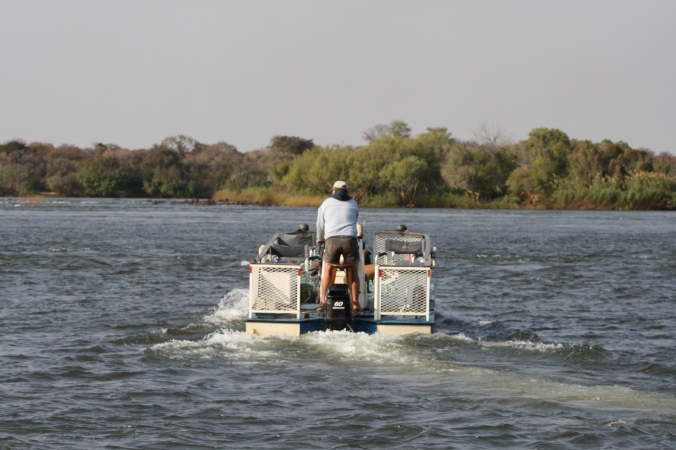
About forty kilometers north of  Seshekeke there used to be a rustic fishing camp on the edge of the Zambezi River, run by an Afrikaans-speaking man from Namibia called Danie (not his real name). During his time in Zambia he became something of a legend among the people of Sesheke.
'Croc Danie'

‘Croc Danie’

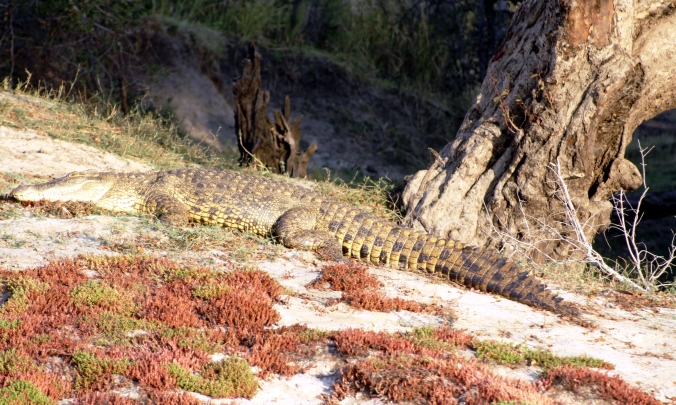
Attacks on humans by crocodiles are common along all African river banks, the Zambezi River being no exception, and if an unfortunate villager is taken or attacked by a crocodile in Zambia  national parks rangers are called to hunt and destroy the perpetrator.
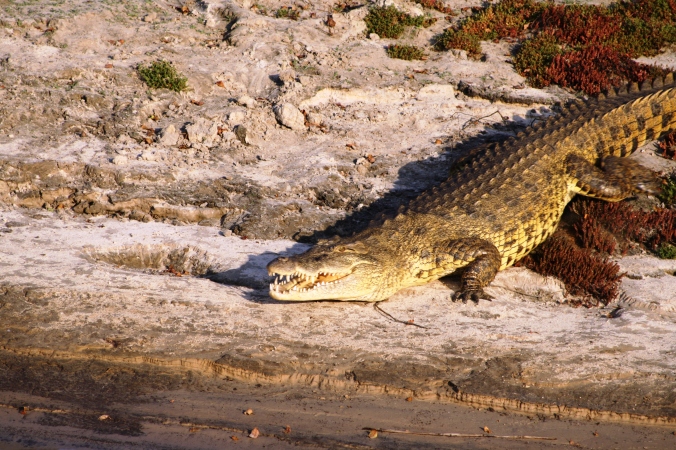
Nile Crocodile (Crocodylus niloticus) - Zambezi River

Nile Crocodile (Crocodylus niloticus) – sunning itself on the banks of the Zambezi River
IMG_0219

Danie was an honorary ranger and often he would be the person to respond to these calls. After shooting the crocodile, national parks take the skin – the Nile Crocodile being a protected species – and Danie would take the meat as payment.  According to Danie some local people believe that crocodile meat has magical powers, rendering the consumer immune to attacks by crocodiles – some even believe that eating crocodile fat can protect you from AIDS.

While the local people avoid going into the water – most do not have the means to obtain crocodile meat to eat for protection – Danie often used to swim in the river as it gets very hot in that part of the World. To the local villagers, the fact that a crocodile had never attacked him meant that he had indeed acquired supernatural powers by eating crocodile meat.

Danie was a wonderful story-teller, his broken English, peppered with the odd Afrikaans word when he couldn’t find the correct term added spice and humour to every tale. He was also quite fond of Brandy and if his stories were told late at night there was often more Afrikaans than English spoken, but I could always get the gist.

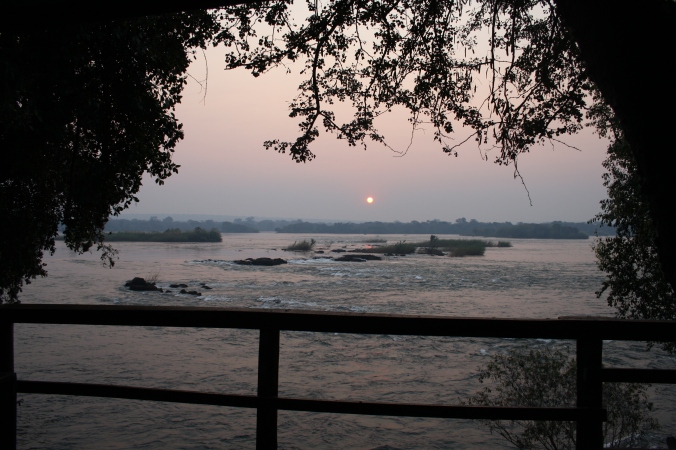
The first time we stayed with him at his camp we were all settled on the deck in front of a crackling fire one evening, relaxing after a day’s fishing in the boat. The sun was setting, the beer was cold and the aroma of meat cooking on the braai was mouth-watering.
IMG_2520

“Did I ever tell you about the time the bus drove into the Zambezi?”  Danie was partly deaf, so shouted most of the time but now he had to shout even louder, the constant roar of the Zambezi rushing over the rapids drowned out most other sounds.

None of us had heard the story then (although it was to be repeated many times after that – and it never got old), so we settled down to listen.

Ag, it must have been three years ago when I got a call from the police station at Sesheke.  The guy told me that a bus had parked next to the river while the passengers all got off to go and do some shopping. Even the driver got out but he forgot to put on the hand brake. Jeez! Can you believe it?

“So of course the bus rolled down the hill and into the river. The whole thing was under the water and, because they think I have super-powers that protect me from crocodiles, they wanted me to come and help them pull the bus out.” Danie paused to take a long pull on his brandy.

“I tried to get out of it. There are lots of crocs in that river, I tell you! And those crocs haven’t been told about my magic powers. But the guy went on and on and begged and pleaded and eventually I had to go and have a look. When I arrived there must have been two hundred people, come from the villages near by, all standing around with their goats and their mombies (cattle) and their children, waiting for me. When I got out of my bakkie (pickup truck) I heard them all saying muzungu! muzungu! (white man! white man!).

“Still trying to get out of this job, I made a phone call to my son. I spoke in English so that the people could hear what I was saying; I hoped they might take pity on this old muzungu and make another plan to get the bus out. I told him about the bus in the water, that there are lots of crocodiles and so I was phoning him to say ‘goodbye’, in case one of the crocs got me and I died.” He shook his head, and took another long sip.
IMG_0221

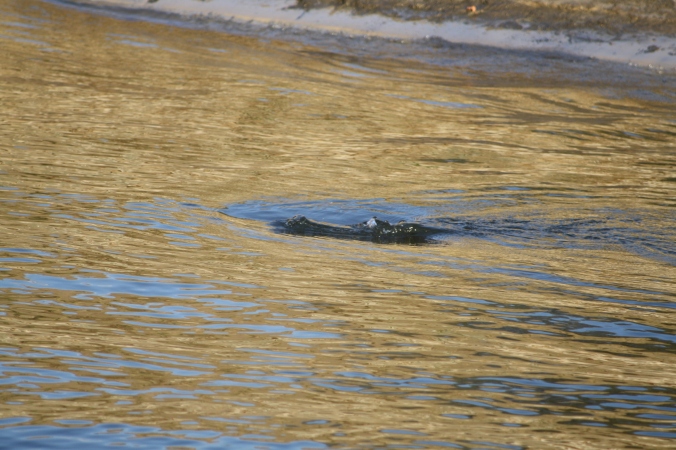
Is it a log? Or is it a crocodile?

“But this plan didn’t work and the policeman handed me a long piece of chain. He wanted me to swim down to the bus and attach the chain to the axle so that the bus could be pulled out with a tractor. I put on my goggles and flippers, said a small prayer and dived into the water. It’s dark and muddy down there but I found the bus and saw that it was suspended in the water with it’s nose down and that there was some air trapped inside at the back of the bus. I opened a window but before I could get into the air pocket I ran out of breath and had to return to the surface.

“By that time my son had arrived; he was worried about his old-man. I saw him standing on the bank and shouted across the water to him in Afrikaans, telling him about the air pocket and not to worry if I didn’t come up for a long time, before diving back down again.

“I was down there a long time attaching that bliksemse chain. Maybe half an hour. Of course all the other people watching from the bank hadn’t understood what I had said to my son and he later told me that they became more and more worried. They all shuffled closer and closer to the water, muttering about crocodiles and how were they going to get the bus out now that the bwana (boss) was dead.

“While I was working on that chain, swimming backwards and forwards through the window for air, I thought about what those people would be thinking and an idea came to me.” Danie was chuckling now as he got up to pour himself another brandy and Coke.

“Once I had attached the chain, I grabbed the other end, took one last big gulp of air and swam under water right up to the edge of the shore, where I could see the shapes of the people all staring out at the water. They couldn’t see me coming because the water is so dirty and when I got really close I burst out of the water, holding the chain high above my head and shouted ‘daar’s hy!’ (‘there it is!’)”. By now Danie was laughing so hard it was difficult to understand what he was saying. Between deep belly laughs he continued:

“Man! You should have seen the chaos. They thought I was a ghost! The people yelled. Women dropped their children and ran. They screamed and they ran, and they kept on running, up to the road at the top of the bank and towards their villages. The goats and the mombies ran. Even the policeman ran!

“The further I walked out of the water the further the people ran, while my son tried to calm everyone down – calling them back and trying to tell them about the pocket of air. No-one would listen and if they did listen they didn’t believe him. It took me a very long time to persuade the policeman to come and take the chain from me, which he did very carefully and reluctantly and with a very long arm, quickly stepping away from me once he had the chain. I think they all still believe I’m a ghost.”


Mosi-oa-Tunya


Cee’s Fun Foto Challenge

This is our last week of the Five Elements/Seasons series and today our topic is Water or the Season of Winter.

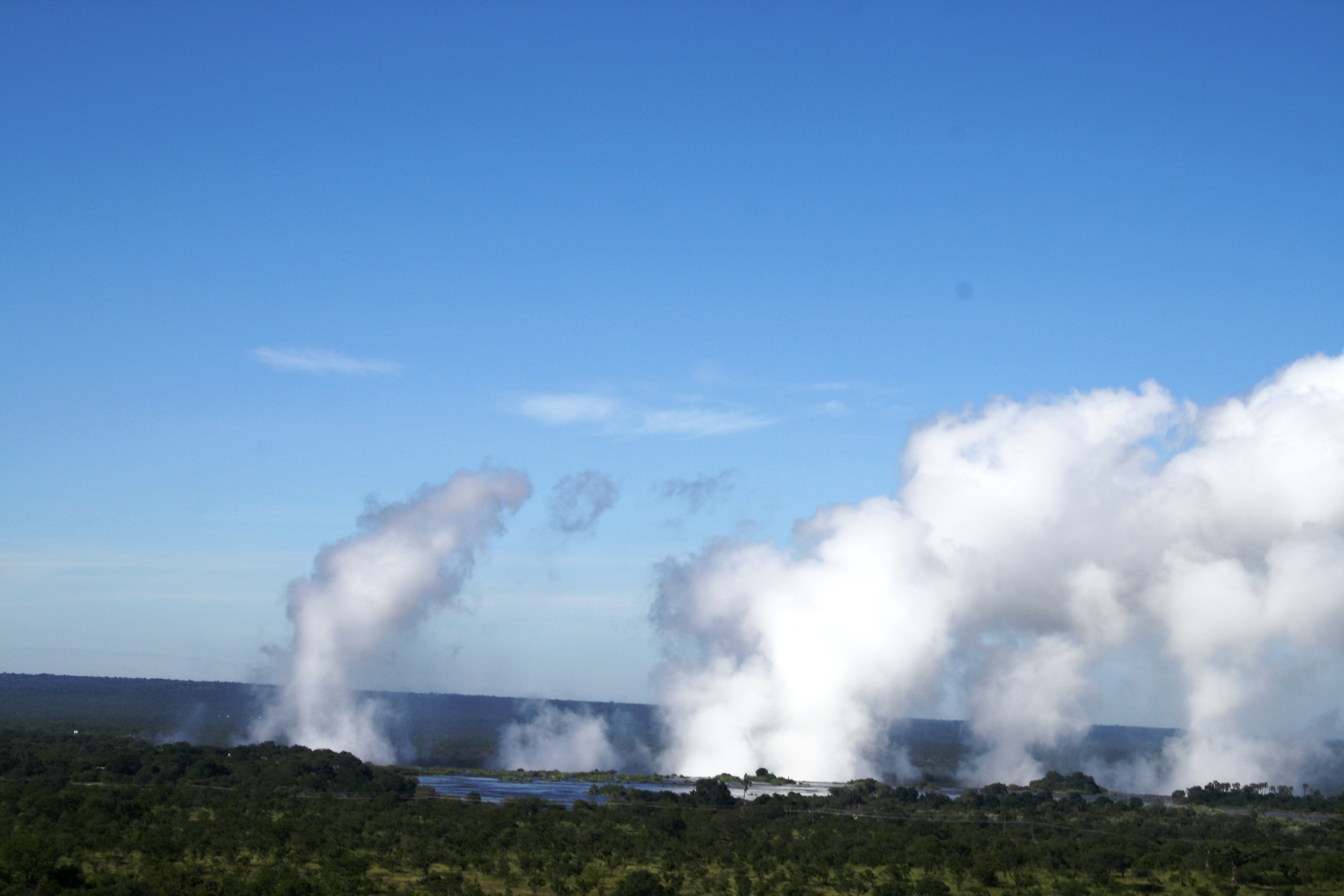
The World’s largest sheet of falling water, the Victoria Falls (or Mosi-oa-Tunya, meaning The Smoke that Thunders in Tokaleya-Tonga) is listed as one of the Seven Natural Wonders of the World – and it falls almost in my front garden!

The Victoria Falls

“…scenes so lovely must have been gazed upon by angels in their flight …” – David Livingstone

IMG_7941

Zambia on the North bank, Zimbabwe on the South. The Zambezi River stretching Northwards as far as the eye can see

Mosi-oa Tunya

The Smoke that Thunders

IMG_7911

Water water, everywhere

Irrigating with water from the Zambezi

The Mosi-oa-Tunya providing a dramatic backdrop to our irrigation – all water is pumped from the Zambezi River

Cees Fun Photo Challenge

The Textures of Africa – Part II


When Piet first arrived here nine years ago the farm now known as Sitikela was bush.  Thick, solid, tangled, dry bush. And it was brown. The trees were brown, the grass was brown, the leaves scattered on the sand were brown – even the sand was brown.

African winter bush

African winter bush

IMG_0134

As he drove up a sandy, unkempt track he noticed the top of a solitary tree towering above the rest of the forest – and it was green! Although it was mid-winter, the heat of the day was almost unbearable and the shade of this tree looked like a likely spot to set up camp; Piet and Sarel, his business partner, lived in tents under that tree for two years while they set to work developing the farm and today our house nestles comfortably in that same shade.

Home Sweet Home

Home Sweet Home

IMG_0106

The rough and the smooth

Guibourtia coleosperma, also known as  Rhodesian Copalwood, African Rosewood and Large False Mopane is a beautiful, mostly evergreen tree which occurs almost exclusively on Kalahari sand. The tree is ubiquitous on our farm and we have at least ten growing in our garden. Our offices are also built under the shade of one of these magnificent specimens.

IMG_0091

I love the varying textures of the bark, smooth, cracked, knotty.

IMG_0094

Pockmarked with borer tunnels

IMG_0122

IMG_0121

The paired leaves look similar to those of the Mopane tree (Colophospermum mopane) which also occurs in this area and it is easy to understand why this tree is sometimes called the Large False Mopane.

Shining emerald green in the sunlight

Shining emerald-green in the sunlight

The leaves look almost translucent from underneath

Almost translucent from underneath

The bright red arils, although somewhat tasteless, are edible and the indigenous people pound them into a flour which they cook into a nutritious meal; they do the same with the seeds and I have read somewhere that this has saved many lives in times of famine.

IMG_0144

IMG_0165

Of course birds love the seeds and arils too, and we are often entertained by the raucous shouting of trumpeter hornbills, sounding uncannily like crying babies as they skirmish and scuffle for the juiciest ones.

IMG_8966

Guibourtia coleosperma  is a much sought-after hardwood. When first cut the timber has a unique pinkish-brown colour which later changes to a rich, warm, edible-looking dark chocolate-brown.

IMG_0169

Our own home-made Rosewood dining-room suite, made from wood salvaged during land clearing


Cee’s Which Way Challenge: 2014 #10


The Mulobezi Express winds its way between Livingstone and Mulobezi – a logging village in the middle of nowhere – and bisects the farm, almost down the middle. We have to cross it many times a day to get to the top fields.

The Mulobezi Express

The Mulobezi Express Line

Derailments are a regular occurrence and often it is out of action for weeks. When this happens the passengers all rally together and using logs as levers and a lot of elbow grease and sweat, somehow manage to lift the train back on its tracks.

When it is in operation we hear it come rattling past twice a week, its wheels screaming in protest – sometimes very late at night – loaded to capacity with people, livestock and goods if it is heading towards Mulobezi, and logs for its return journey. It sounds as if it is heading directly towards the house, which is very unnerving and the dogs always go barking crazy, tearing up and down the fence shouting insults.

Maintenance is a very loose term in this part of the world but from time to time a crew of men are sent along the line to check for problems and, if they can, to fix them. They are always a cheerful bunch and we can often hear their laughter and singing echoing through the trees as they make their way deeper into the forest (the dogs don’t like this either!).

DSCF5565

The Maintenance Crew

Cee’s Which Way Photo Challenge

043014-which-way

An Elephant Never Forgets – Post Script


Two days after our close encounter we were again driving home through the park when we noticed a lot of dust blowing into the road up ahead. It was late afternoon, the sun was very low in the sky and visibility was not great, so we slowed right down; if a herd of elephants was about to cross we didn’t want to run straight into them. As we drew closer and were engulfed in the dust cloud we saw that it was indeed a large herd of elephants moving through the bush on our right hand side.

We were alongside the herd when suddenly, from the opposite side, a tiny baby elephant came rushing out of the bush – directly into the path of our vehicle. Thank goodness for Piet’s quick reactions (and for ABS brakes)! We screeched to a halt not more than two metres before hitting the elephant – who was now squealing with fright, his bum tucked in, his trunk straight out, his little legs a blur as he made the final dash to his Mum and the rest of his family.

In the moments before we gathered our wits and drove off we could hear his Mum reassuring him with her low, rumbling murmurs.

Thankfully we were in a different vehicle, not the elephant-chasing one. The elephants didn’t recognise us and we were left to carry on our journey home unscathed.

An Elephant Never Forgets


Last Tuesday we were driving through the park on our way home from town when we noticed a mini-bus parked on the side of the road. This usually means there is something worth looking at, so we slowed down to see what they had stopped for and pulled up behind them.  Every head in the bus was turned to the right, necks craning as they tried to get a better look at something there in the bush. We followed the direction of their gaze, struggling at first to see what it was – and then suddenly there they were! Lumbering slowly into view came an elephant cow with her very small calf and an older sibling also in tow.

She kept her calf tucked away, mostly out of sight

Big brother

We sat watching and hoping for the opportunity for some decent photos when she suddenly lifted her head and looked directly into Piet’s eyes.  She uttered a low, rumbling sound, shook her head and started moving directly towards our truck.

Here comes trouble!

It was around about now that I became distracted and forgot to take any more pictures!

At this point Piet engaged gears and quickly pulled out into the road. By the time we had passed the mini-bus the elephant was on the road, running after us and screaming; her ears pinned back and her trunk down. She too overtook the mini-bus, its stunned occupants gaping after us, open-mouthed.  She appeared intent on catching only us and it was only after we had retreated some distance that she turned around and loped off, back into the bush to join her two children.

The elephants in our park are not normally aggressive but I have a theory about why this cow took umbrage.  I reckon that she belongs to one of the many herds that regularly raid our crops in the winter months. The vehicle we were traveling in is the same one Piet uses for his nightly chasing-the-elephants-out-of-our-crops escapades. She most likely recognised the sound of the vehicle and probably also the smell of Piet, associating those two things with being harassed and deprived of our juicy, tasty maize (corn) and wheat when there’s not much else around to eat. She remembered her frustration and here was the perfect opportunity for her to show us just how annoyed he had made her so many times in the past.

Indeed, an elephant never forgets!