A Close Encounter


Zambezi Elephant Trails is home to nine tamed and trained African elephants and is based inside The Mosi-oa-Tunya National Park, just a short drive from Livingstone in Zambia. There tourists are offered the unique experience of interacting closely with one of Africa’s most magnificent animals. After a short briefing by staff, guests are encouraged to walk in the bush alongside the elephants, observing them in their natural habitat – unchained and unhindered. Later the elephants are saddled up and a short ride through the bush follows.

After the ride is over the elephants are left to continue grazing and they wander through the bush for the rest of the day, living as wild elephants do, only returning to their stables after they are called by their handlers in the evenings. They are called by name and it is remarkable to see these giant beasts responding, lumbering over to their handlers and obediently going into their stables for the night.

All of the original six adult elephants living at Zambezi Elephant Trails were rescued as orphans in Rhodesia (now called Zimbabwe) between the 1960s and the 1980s. Of the remaining three, two are offspring of the tamed elephants and one is a calf who was found abandoned on a nearby island in the Zambezi River.

One afternoon in 2010 the elephants had crossed over to graze on Sekuti Island, which is directly across from the base on the Zambezi River. When the handlers called them to come in for the night they all entered the water and started swimming back across. It was then that the handlers noticed there was an extra calf with them. He had attached himself to one of the cows in the herd called Mashumbi – they refused to be parted from one another and he followed her straight into the stables! A search on the island found no other elephants there, checks with elephant population researchers revealed that no wild breeding herds had been seen in the area for a couple of months and from this it was deduced that this little guy had been abandoned some time ago and had somehow managed to survive this long on his own. He had been fully accepted by the Zambezi Elephant Trails herd and the Zambian Wildlife Authority agreed to give custody of him to them – he was named Sekuti after the island where he was found. He is still being fed milk supplements (elephants can continue to suckle from their mothers until they are 10 years old) and Sekuti follows the herd wherever it goes, learning good manners through positive reinforcement along the way.

Bop and Danny are the oldest bulls;  they were both orphaned during culls in the Mana Pools National Park in the Lower Zambezi area of Zimbabwe. Danny is now about 40 years old and Bop, nearing 60, has recently been retired.

In the 1980s a very severe drought left many elephants – and other wildlife – struggling to exist in the already dry and harsh climate of the Gonarezhou (meaning “Place of the Elephant”) National Park in Zimbabwe. As a consequence of the drought a number of baby elephants were abandoned by their herds. These babies were rescued and taken in by some local farmers, who hand-reared them and cared for them for many years afterwards.

At around that time Clem Coetzee, a renowned Zimbabwean conservationist, had started to develop a method of positive reinforcement training for elephants and the farmers decided to try it out on their foster babies – with great success. Soon they were riding the elephants around on their farms and this later developed into an elephant back safari business.

The other four adult elephants at Zambezi Elephant Trails, now ranging in age from 30 to 38 years old, were part of that group of babies from the Gonarezhou. I was living near the Gonarezhou at the time of the drought, those farmers were people I knew and I visited the farm where the babies were being held before moving to their new foster homes. I can remember the pitiful sight of those babies, I could sense the despair they seemed to be feeling – some aimlessly pacing inside their pen, others crying real tears as they stared listlessly through the bars. That image and that feeling of sadness will never leave me.

Little did I know then that I would meet them again all these years later and to see them now, as happy, well-adjusted adults living in a cohesive family group is an uplifting experience.

1-IMG_6904

1-IMG_6920

IMG_6937

1-IMG_6956

1-IMG_6914

1-IMG_6954

1-IMG_6950

1-IMG_6949

IMG_6947

1-IMG_6960


To see more Black and White Close-Ups, visit Cee’s Photography Blog

At the Airport at High Noon


At noon today, take a pause in what you’re doing or thinking about. Make a note of it, and write a post about it later.


I wrote this post on Sunday for the Daily Post Postaday Prompt: High Noon. As is the norm in these parts, when it rains electricity supply and the internet become unreliable, so it has taken me many frustrating attempts to get it published.

In fact, if our house had windows, there would be a computer-shaped hole in one of them by now!


Our nearest airport is not very busy. Only three international and two local flights arrive a day – most of the passengers are Bucket List People coming to visit Victoria Falls, adrenalin junkies seeking their next thrill and sometimes a handful of businessmen and investors.

Joe was supposed to have flown in yesterday from Johannesburg, but our  late rains put paid to that.

Piet got to the airport at mid-day to collect him and within minutes the plane could be heard circling above, hidden behind a heavy bank of clouds. It kept on circling for quite some time, round and round and round, once appearing for a brief moment before being sucked up again into the dull greyness. Then silence. No more circling plane and no announcements over the public address system. People started to get restless and then panicky, the low mumblings getting louder with each question.

“What’s going on?”,

“WHERE HAS IT GONE?”,

WHY AREN’T THEY TELLING US ANYTHING?

One of our friends who owns a helicopter touring company was also at the airport to collect his wife. Being in the business, he has all the passes necessary to get in to those areas the rest of us never see at an airport. So after about half an hour had passed and there had still been no announcement, he decided to nip up to the control tower to see if he could find out what had happened to the plane.

It turns out that when the plane made that brief appearance below the clouds it had been coming in for final approach to land. However, the constant driving rain and electrical storms had interfered with the navigation instruments on the ground and had the pilot continued with his downward trend the plane would have landed directly on top of the airport building! After hastily pulling back up above the clouds he continued circling while trying to establish a better connection with the people in the tower and continued doing this until an impromptu diversion to Lusaka Airport – an hour and a half away – was necessary for refuelling.

Refuelling took an hour, and by this time Joe, tired of being cooped up in such a small space – he is a large man and needed to stretch his legs – asked if he could disembark. Being told “if you get off you can’t get back on again” slightly annoyed him, so he asked if he could be served a drink instead. “It is against the airline’s policy to serve alcohol while on the ground” was the curt reply. There is a bus service which runs between Lusaka and Livingstone (it’s a six-hour journey) and Joe had started to seriously consider getting off the plane and catching that bus when the pilot announced that the tanks were full and they were going to head back to try to land again.

A bit more circling over the airport and three hours later they had landed. Back in Johannesburg.

Eight hours of flying later they were right where they had started!

Being Easter Weekend all the flights were fully booked, an extra plane was laid on and so today Harry Mwaanga Nkumbula Airport received four international flights. Joe arrived safely on one of them.

And that’s why today at noon I was at the airport.

1-20150405_123836


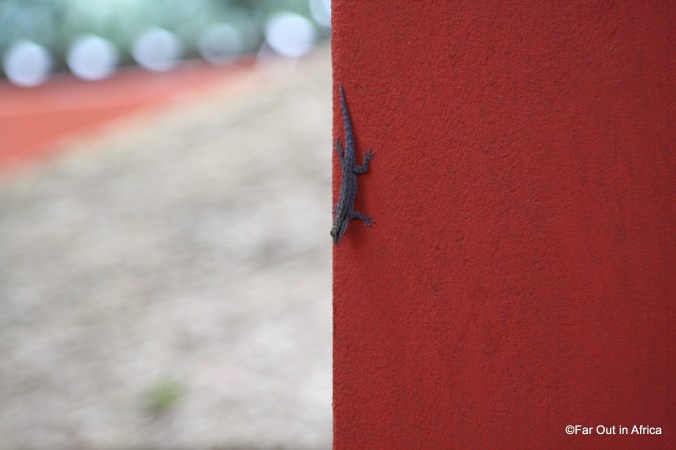
Salamander, Zephyr, Dusketha and Breama


Song of Four Fairies – John Keats

Salamander
Happy, happy glowing fire!
Dazzling bowers of soft retire,
Ever let my nourish’d wing,
Like a bat’s, still wandering,
Faintly fan your fiery spaces,
Spirit sole in deadly places.
In unhaunted roar and blaze,
Open eyes that never daze,
Let me see the myriad shapes
Of men, and beasts, and fish, and apes,
Portray’d in many a fiery den,
And wrought by spumy bitumen.
On the deep intenser roof,
Arched every way aloof,
Let me breathe upon their skies,
And anger their live tapestries;
Free from cold, and every care,
Of chilly rain, and shivering air.

Let me see the myriad shapes Of men, and beasts, and fish, and apes

Zephyr
Spirit of Fire! away! away!
Or your very roundelay
Will sear my plumage newly budded
From its quilled sheath, all studded
With the self-same news that fell
On the May-grown Asphodel.
Spirit of Fire — away! away!

1-Pictures 031

Breama
Spirit of Fire — away! away!
Zephyr, blue-ey’d Faery turn,
And see my cool sedge-bury’d urn,
Where it rests its mossy brim
‘Mid water-mint and cresses dim;
And the flowers, in sweet troubles,
Lift their eyes above the bubbles,
Like our Queen, when she would please
To sleep, and Oberon will teaze.
Love me, blue-ey’d Faery, true!
Soothly I am sick for you.

1-IMG_1247

Zephyr
Gentle Breama! by the first
Violet young nature nurst,
I will bathe myself with thee,
So you sometimes follow me
To my home, far, far, in west,
Beyond the nimble-wheeled quest
Of the golden-browed sun:

1-Swallows 1

Come with me, o’er tops of trees,
To my fragrant palaces,
Where they ever floating are
Beneath the cherish of a star
Call’d Vesper, who with silver veil
Ever hides his brilliance pale,
Ever gently-drows’d doth keep
Twilight for the Fayes to sleep.

1-air 1

Fear not that your watery hair
Will thirst in drouthy ringlets there;
Clouds of stored summer rains
Thou shalt taste, before the stains
Of the mountain soil they take,
And too unlucent for thee make.
I love thee, crystal Faery, true!
Sooth I am as sick for you!

1-air and water 3

Salamander
Out, ye aguish Faeries, out!
Chilly lovers, what a rout
Keep ye with your frozen breath,
Colder than the mortal death.
Adder-eye’d Dusketha, speak,
Shall we leave these, and go seek
In the earth’s wide entrails old
Couches warm as their’s are cold?
O for a fiery gloom and thee,
Dusketha, so enchantingly
Freckle-wing’d and lizard-sided!

IMG_6369

Dusketha
By thee, Sprite, will I be guided!
I care not for cold or heat;
Frost and flame, or sparks, or sleet,
To my essence are the same;–
But I honour more the flame.
Spirit of Fire, I follow thee
Wheresoever it may be,
To the torrid spouts and fountains,
Underneath earth-quaked mountains;
Or, at thy supreme desire,
Touch the very pulse of fire
With my bare unlidded eyes.

1-fire and earth

Salamander
Sweet Dusketha! paradise!
Off, ye icy Spirits, fly!
Frosty creatures of the sky!

1-Pictures 109

Dusketha
Breathe upon them, fiery sprite!

Zephyr and Breama
Away! away to our delight!

1-air and water 1

Salamander
Go, feed on icicles, while we
Bedded in tongue-flames will be.

IMG_6361

Dusketha
Lead me to those feverous glooms,
Sprite of Fire!

ephemeral

Breama
Me to the blooms,
Blue-ey’d Zephyr, of those flowers
Far in the west where the May-cloud lowers;
And the beams of still Vesper, when winds are all wist,
Are shed thro’ the rain and the milder mist,
And twilight your floating bowers.

1-air and water 2